Category Archives: Elm Court

Round Two

As reported by the Berkshire Eagle, Front Yard LLC recently submitted its application for a Special Permit to the Lenox Zoning Board of Appeals. The Lenox Zoning Bylaw identifies conditions for approval that are strikingly similar to the Stockbridge criteria, though they were largely  ignored or trivialized by the Stockbridge Selectmen.

Those six specific areas of concern are highlighted below, in bold. We trust that the Lenox ZBA, with input from the Planning Board, and from truly independent consultants, will carefully consider the long list of questions that went unanswered in Stockbridge.

1. Community needs served by the proposal.

Has the applicant persuasively demonstrated the need for yet another spa resort in our community? What market analysis and demographic projections have they submitted to substantiate the need for this resort? What is their business model, and how does it compare to other large resorts such as the recently permitted Spring Lawn development? What impact will this massive development have on our B & Bs and existing inns and resorts?

As for claims of new jobs: have they submitted detailed information as to the wage and salary structure of their proposed staff? Will these wages and salaries permit employees to actually live in Lenox, with their children attending Lenox schools?

Does this proposal meet the statewide criteria for “Smart Growth”? The answer to that would be an obvious “NO”, in stark contrast to the Spring Lawn development, which does in fact meet most of those criteria. Numerous young (21 and under) Berkshire residents stated during the Stockbridge “hearing” that their vision of the future Berkshire economy centers on local food production, small creative businesses and sustainable enterprises, NOT on franchise-style resorts such as the proposed big-box annex at Elm Court. Such testimony fell on deaf ears. While many will pay lip service to the “needs of Berkshire young people”, very few ever listen to what they have to say.

We urge everyone within the process to keep in mind that the parent company Amstar is not in the resort or hospitality business; they make their money on the exit from properties. There is no guarantee that the “Travaasa” brand will be around in five years from now, let alone a generation or two. What happens when they flip the property to Hilton, who then flips to Holiday Inn, and onwards down the food chain?

2. Traffic flow and safety, including parking and loading.

The materials submitted by the applicant are restricted to idiotic “level of service” traffic studies, using a methodology that is truly in the dark ages of pseudo-science. Our position from the start has been that this methodology may be fine for evaluating whether to put another Dunkin’ Donuts in downtown Pittsfield, but is wholly irrelevant to evaluating the impact of dropping a 112 room mega-resort into an historic, residential neighborhood. Our concerns center around safety, having to do with the road topography and alignment characteristics, as well as with speeding and other driving behaviors that suggest that adding a major new category of traffic will end in tragedy.

Beyond those “big picture” concerns: how will staff be trained to arrive and depart work? How will large commercial service vehicles be routed, to mitigate safety and noise concerns in the neighborhood? How will guests be directed to arrive to the resort?

Much has been written about the idea of a sidewalk; it should be clear that while there are some neighborhood residents who favor a sidewalk, there are many others who believe that such an “amenity” will further destroy the character of our neighborhood. Surely, such a major project can only be pursued on the basis of solid consensus. At present, there is no such consensus – far from it!

3. Adequacy of utilities and other public services.

We are aware that there is adequate capacity at present to serve the water and waste needs of the proposed development. However, large projects inevitably carry unforeseen consequences, and thus it is prudent to make sure that the town is protected should the sewage hit the proverbial fan in the future. To build new town infrastructure just because because a single corporate land owner promises to pay for it (short term) represents a terrible way to conduct local planning. It’s the sort of impulsive money-grabbing that invariably creates major headaches down the road.

4. Neighborhood character and social structures.

The most respected neighborhood character expert in New England expressed dismay that such a massive project would ever be considered in a low-key, family oriented neighborhood such as Old Stockbridge Road. His detailed report is available here, and summarized here. For a general description of existing neighborhood character from the point of view of those who live here, see this post.

There is a persistent rumor that the applicant intends to market the Elm Court facility as a regional Wedding Mill, with multiple weddings scheduled every day of the wedding season. Such intensive use (particularly on weekends) would have massive impacts on the ability of residents to enjoy their properties in peace and quiet, as well as raising serious safety concerns of alcohol use and driving on our hilly, winding road. Reasonable limits must be placed on the hosting of weddings and other such events, e.g. one per weekend.

Similarly, the restaurant should not be open to the public; does the town of Lenox truly suffer from a dearth of restaurant options? We think not.

5. Impacts on the natural environment.

Much has been said about how this proposal protects “open space”; yet there is presently no guarantee that this is not merely Phase A of a far more intensive development yet to come in Phase B and Phase C, via townhouses, condos, mansion “units” and other amenities such as tennis courts, stables, etc. Will the applicant agree to placing a Conservation Restriction on the rest of the property, held by the Lenox Land Trust, or by the Berkshire Natural Resources Council?

6. Potential economic and fiscal impact to the Town, including impact on town services, tax base, and employment.

We do not know what the impact will be; and in the absence of a professional, independent study and analysis based on hard data from the hospitality industry, neither does anybody else. It is easy to say that “all development is positive”, but what happens if, over the long term, as this resort slides down the hospitality industry food chain, the value of adjacent properties (most of which are in Lenox) depreciates by 30%, or even 50%? What happens to the tax base then? Or: what happens if this resort is the final blow to our B & Bs, most of which are already struggling to sustain themselves? Lenox could well end up with a net fiscal loss to the Town, a loss that will make any short-term fee revenues appear like fool’s gold.

———-

Following the one-sided and unfair process that unfolded in Stockbridge, we trust that the Lenox Planning Board and ZBA will consider all issues objectively, with particular attention to the legitimate and deeply held concerns of abutters and other directly impacted neighbors and longstanding town citizens, concerns that were summarily dismissed during the sham process in Stockbridge.

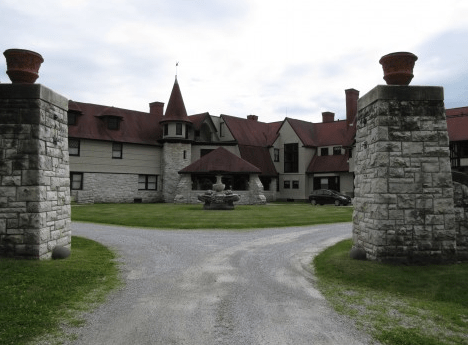
We urge that Town Manager Chris Ketchen, Town Planner Gwen Miller and members of both the Planning Board and ZBA walk (not just drive) down Old Stockbridge Road, and get a sense for the neighborhood and the character of the road, from ground level. We extended this same invitation to the Stockbridge Selectmen, though it seems they were only willing to attend tea & champagne parties at Elm Court.
A Very Bad Fit

Among the many materials ignored by the Stockbridge Board of Selectmen during their kangaroo hearing, there was a report researched and submitted by a nationally recognized expert on neighborhood character, Dr. John Mullin.  He writes:

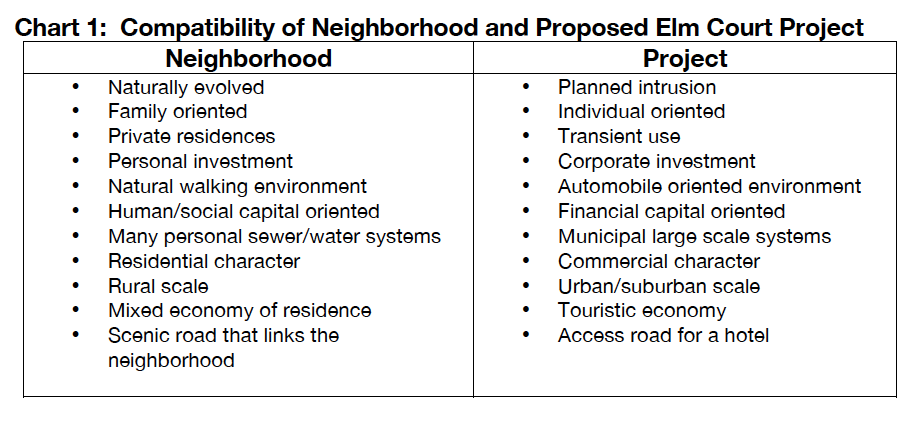
There is no definition of the neighborhood in the submitted material. Concerning the physical characteristics, it is a long settled and established neighborhood, marked by the gentle curves and slopes of a narrow scenic road, without the need of sidewalks. It is a place of multigenerational families, committed to place and community, who enjoy the seasons and the natural environment. Their homes can be characterized by steady reinvestment with a significant number relying on their own water and sewer systems. I would ask the applicant to compare these traits with their proposal to determine the degree of compatibility between the neighborhood and the project. It would appear that they are not.

Dr. Mullin then includes an excellent chart that compares the values and qualities of the neighborhood to the values and qualities of the proposed resort. This chart clearly demonstrates that dropping a corporate mega-resort into an established residential neighborhood is a very bad fit.

chart

Did the Stockbridge board of Selectmen consider these excellent points? Of course not, since their minds had already been made up, many months before. They smelled money, and figured there was no downside to a project where the revenues would accrue to Stockbridge at the expense of a neighborhood that was located for the most part in Lenox. People in the neighborhood were belittled, bullied and ignored.

So will the various Lenox boards pay closer attention to the expertise and analysis of Dr. Mullin? We hope so, but it seems that many towns don’t care anymore about neighborhoods or families: corporations, and their interests, rule the roost. Unfortunately for our towns, such a large and ill-considered scheme is likely to carry very substantial unintended consequences, and the smell of money may quickly turn into a far less welcome stench.

We urge Lenox board members to exercise maximum due diligence and to pay close attention to every aspect of this project, above all, input from the people who actually live here.

The Telling Detail

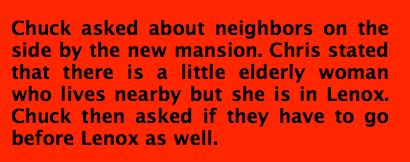
Sometimes, the deeper meaning of a long story finds expression in a single document. So it is with recent minutes of the Stockbridge Board of Selectmen, that offer readers a sad chronicle of naive boosterism and derogation of due process. Here is a snippet from those minutes early in the process of “reviewing” (read: shamelessly promoting) the Amstar proposal for Elm Court:

Screen Shot 2014-09-13 at 1.23.49 PM

Chuck is Selectman Charles Gillette; Chris is Chris Manning, one of the former presidents of the revolving door real estate operation that carries the pseudo-Sanskrit brand name “Travaasa”. The snippet speaks for itself, but here’s the neighborhood response to Mr. Gillette, Mr. Manning and to Travaasa president-du-jour Adam Hawthorn: that “little elderly lady” has a name, and a life, and a residency on Old Stockbridge Road that spans five decades. She deserves to be treated with respect, not dismissed as powerless, and thus considered irrelevant. Rather than caution Mr. Manning for his arrogant statement, Mr. Gillette merely wonders if the fact that “she is in Lenox” may become a problem. So much for the ideals of public service!

The Stockbridge minutes are full of telling vignettes such as this one; we recommend them to all Stockbridge voters. Is this who you are, the sort of town you wish to be? Do such “leaders” truly represent the best and brightest of Stockbridge and the Berkshires?  

A Few Pertinent Facts

stockerselectmen-470x352

UNTROUBLED BY FRESH QUESTIONS AND NEW INFORMATION

On the evening of September 8, in a decision likely to go down in Stockbridge history as the worst ever, and one that may haunt the town mightily in years to come, the three sitting members of the town Board of Selectmen (BOS), acting as the Special Permit Granting Authority (SPGA), gave permission to Front Yard LLC to proceed with their plans to drop a huge commercial resort into the middle of an existing residential neighborhood. For fee payments and tax income that may well turn out to be illusory, the BOS thereby sold out the longstanding residents of Old Stockbridge Road, some of whom have been there for decades, and many of whom actually bought their lots from previous owners of Elm Court.

One young citizen who attended the meeting told us that he was so disturbed by what he had witnessed that he was questioning whether he wanted to continue to live in the Berkshires. Others told us they thought the entire process had been a sham. Though equally shocked by the refusal of the SPGA to carefully weigh and consider relevant factual evidence, all of the evidence, through rational deliberations, we were not at all surprised by what transpired over the course of the hearing. We had facts that strongly suggested that the decision to approve had already been made, way back in 2012. But don’t take our word for it; here are their own minutes.

FACT I

For the BOS meeting of June 13, 2012, we find the following, with red highlighting added for emphasis; the “Chris” mentioned is Chris Manning, the now-departed former President of Travaasa: BOSjune13 Mr. Shatz knew that he would eventually preside over the hearing for a special permit as the Chair of the SPGA, yet there he was back in 2012 actively coaching the applicant as to how they could slide a bylaw amendment designed to facilitate the approval of this one property through an unpredictable Special Town Meeting on zoning issues that was eventually scheduled for February 19, 2013. Even though that meeting was subsequently presented with an  incomplete and inaccurate description of the project, and even with all that preparation and help from the Selectmen, the amendment still did not pass. What to do?

FACT 2

Here we are on March 6, 2013:

march62013

Owner Bob Berle and his attorney, David Hellman, who would subsequently become the attorney for Front Yard LLC, then went away and did what they were told: they crafted a freshly worded amendment, tailor made for Elm Court.

FACT 3

They return on March 27:

march272013 At the regular 2013 Town Meeting to follow, the BOS gave a ringing endorsement to this amendment, written by the owner’s attorney in consultation with the BOS; Amstar once again presented a partial and significantly smaller version of their plan; a few emotional pleas were made to “save Elm Court”; and the amendment finally passed.

Then came the time for those same three members of the BOS – Mr. Gillette, Ms. McMenamy and Mr. Shatz –  to put on their hats as the SPGA, a role in which they are supposed to have open minds throughout an objective and impartial process. Not easy for them to do, having been such eager and supportive Berle/Amstar cheerleaders for the previous two years!

Mr. Gillette, for example, thought that the Town Meeting vote on a bylaw amendment was an indication of unambiguous support for the project, and that his thinking cap could thus be placed on a high shelf somewhere; at least, such was the crux of his statement following the decision on Monday night. As for the Chairman Mr. Shatz, despite strong and relevant new information and analysis entered into the record, he was so convinced of the gratuitous irrelevance of his own SPGA hearing that he had already written up his findings before the evening had even begun!

We leave it up to each reader to reach their own conclusion regarding the ethics of all this, but we can comfortably assert that such behavior is highly irregular for an SPGA, and should raise serious questions, for all concerned residents of Stockbridge.

Do you want the same people who serve as boosters and political consultants for commercial developers to then preside over the permitting process? Is this good for the town and in the public interest, over the long term? Should not the members of the Stockbridge BOS, deeply involved in enabling this project through the bylaw amendment, have recused themselves as the SPGA, and deferred to their Zoning Board of Appeals? Again, we leave each reader to reach their own conclusion.

We close with Article XXIX of the Constitution for the Commonwealth of Massachusetts that expresses a noble, fundamental principle for the rule of law reaching all the way back to Magna Carta:

FACT 4

article29 To all those who witnessed this process, and to all those who have duly examined the above three excerpts from the Stockbridge BOS minutes: do you believe this properly high ethical standard has been met?

Size Matters

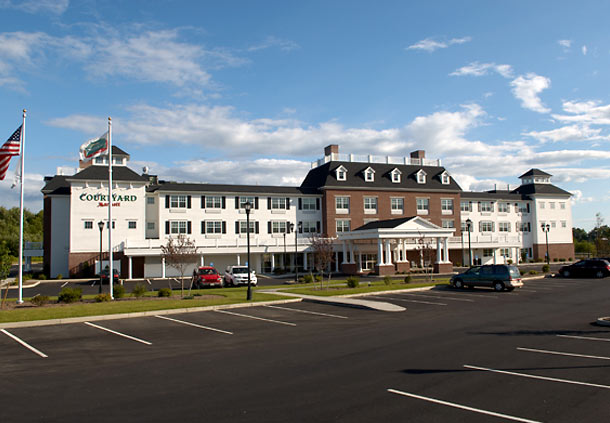
Many people still do not comprehend the size of the hotel “annex” under consideration. Here is a 96-room Courtyard by Marriott located not far away, in the Hadley/Amherst area:

96 ROOM COURTYARD BY MARRIOTT

96 ROOM COURTYARD BY MARRIOTT

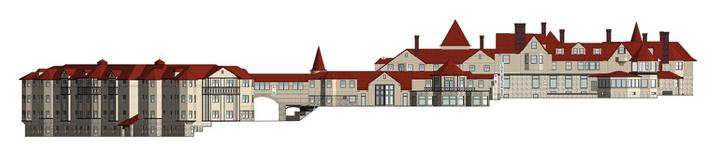
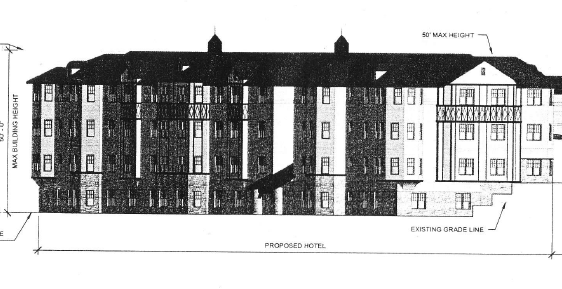
And here is the proposed “annex”:

ELM COURT ANNEX HOTEL AS PROPOSED

ELM COURT ANNEX HOTEL AS PROPOSED:  THIS IS A VERY BIG CHUNKY HOTEL

Amstar is also proposing a 104 space parking lot, as their main “valet service” parking. The photo below shows 80 spaces — so add another row for good measure.

aerialparking

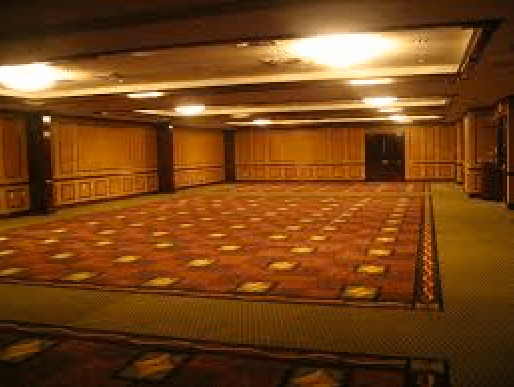
Finally, the proposed “spa” (who knows what it will really be used for) is another 15,500 square feet. Here is what that looks like, in the form of the “Sugar Land” Ballroom, located inside a Texas Marriott, famous as a wedding mill.

SUGAR LAND: COMING SOON TO ELM COURT!

SUGAR LAND BALLROOM @ 15500 SQUARE FEET: COINCIDENCE, OR COMING SOON TO ELM COURT?

Every aspect of the proposed resort is way too big. All historical value on the grounds and in the neighborhood will be crushed by this monstrous new “facility”. Those who claim that this is the only way to “save Elm Court” remind us of how Tacitus described the Roman legions: They make a desert and call it peace.

Alternative Futures

Supporters of the big-box franchise-style hotel “annex” plus the public spa and large restaurant now being proposed for Elm Court continue to play the emotional card: either build this massive resort or Elm Court will collapse into ruin.

To be blunt, this argument is total nonsense. There are many alternative uses; and there is certainly a far better process for building consensus and conceiving a sustainable future use for the property, one that does not create economic viability by destroying the existing neighborhood.

For example:

The Board of Selectmen could establish a committee of neighbors, concerned citizens and planning officials from both Stockbridge and Lenox to research alternatives. Just to get the ball rolling, here are a few ideas.

1. A smaller spa hotel with 32 rooms, 16 of which would be located in a wing similar in architectural style to the present “Billiard” wing, or put additional guest rooms in one of the houses on the southern end of the property (the Gardener’s Cottage, the Butler’s Cottage, the Stables, etc.).

2. Finish restoration of the mansion; involve Trustees of Reservations in running Elm Court as an historic hotel similar to but larger than the lovely restored mansion, The Inn at Castle Hill, on the Crane Estate run by the Trustees of Reservations. All rooms and facilities within the existing footprint. True restoration!

3. A development similar to Bishop Estate, which has 19 houses with most land held in common, as part of restored Beartix Ferrand landscape plan.

4. A development similar to Winden Hill, which has 28 units, in roughly 12 buildings on 60 acres.

5. Try again in this time of economic recovery to sell to an individual who would restore the building for personal use or for use as a luxury boutique Hotel.

6. Attract a small organization (think tank, academic research center, graduate program in 19th century American studies, etc.) to make Elm Court its headquarters, similar to the American Institute for Economic Research in Great Barrington.

7. Restore Elm Court to its original, smaller size and make it the Club House/Event Space for an association of architecturally harmonious houses on estate grounds.

These various approaches are only a start. Surely, a committee charged with exploring these and other concepts could develop a solid list of ideas worth exploring in more detail, with input from planning professionals. Rushing a project of this scale virtually guarantees massive unintended consequences. Let’s slow down, begin again and do it right!

Neighborhood Character

The applicant’s website makes the following statement regarding “neighborhood character”:

Screen Shot 2014-08-22 at 10.03.14 AM

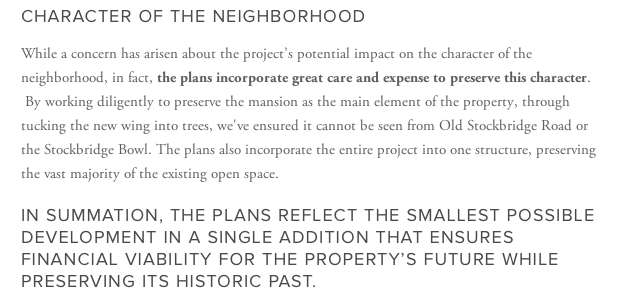
Strangely, the above seems to imply that neighborhood character is something to be seen but not lived; that character is just a series of snap shots or postcards. That is not how our neighborhood understands character.

At the moment, Old Stockbridge Road remains a quiet, family-oriented, pedestrian-friendly low-key neighborhood with a balanced mix of year-round and seasonal residents. The onset of construction chaos and excavators, followed by headlights at night, round the clock commercial and service vehicles, hotel and restaurant staff shift changes, endless streams of transient guests speeding back and forth to various events, parking lots for 160 cars, and a general continuous year-round commercialized buzz at the heart of the historic landscape would have severe detrimental impacts to the existing character of the neighborhood, both in the present and in the future.

Both the applicant and town officials should listen more carefully to residents who have lived in the neighborhood, in some cases for many decades. We know the quality of life that we now have; and we know what we stand to lose. The commercial footprint for this proposed giant step commercial expansion would be extremely heavy, forever changing the human ecology and balance of the neighborhood. With regards to the road itself, both Stockbridge and Lenox would lose one of the Berkshire’s priceless historic assets. A pedestrian-friendly and compellingly beautiful former Gilded Age carriage path would be transformed into just another run-of-the-mill commercial thoroughfare. Pedestrians, children and bicyclists will be driven off our road, to find safer rural byways.

As for their statement that this massive resort represents the “smallest possible development”: that one defies all reason. Where are the marketing studies that back this statement up? Where is the business plan? Where is the analysis, or the rational argument? More than doubling the size of an enormous existing mansion is the “smallest possible development”?

As for the statement about historic preservation, we reply that history is more than views and mansions. The fastest way we can think of to destroy the gracious historic character of our scenic former carriage path and revolutionary-era post road would be to build a massive commercial resort.

sprawl

NOTHING SMALL ABOUT THIS

What About Traffic?

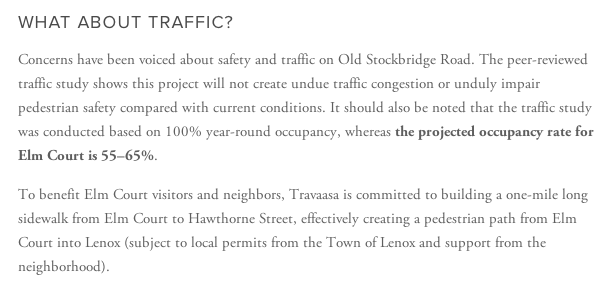
On the developer’s own website, we find the following highly misleading statement:

traffictravaasa

Their study centers on a purely quantitative analysis called “level of service”. For example, they ask if the increase in hundreds of cars and trucks per day will delay a resident on Bean Hill Road from turning left onto Old Stockbridge Road. Then they generate reams of data taken over a few sample hours during the week to cook up the inevitable answer: No Impact.

Though in our view such studies represent the most crass form of pseudo-science, let’s assume there are no problems on the quantitative side of the street. The problem is, we live on the qualitative side of the street. And there is simply no way to argue that the noise and safety impacts of hundreds of service trucks and cars will not detract from the quality of life on our quiet, residential and pedestrian-friendly street. There is also no way to argue that hundreds of trucks and cars will not change the qualitative experience of the road for visiting pedestrians and bicyclists. In fact, they will soon be erased from the scene, and will seek quiet by-ways elsewhere.

While there may be no impact regarding level of service, the impact on our quality of life will be dramatic. As an illustration, let’s imagine the pool at the proposed 15,000 square foot Travaasa spa. Now in terms of it’s “level of service”, it is likely to be able to accommodate hundreds of human bodies, and perhaps even a shark or two. But is this really the quality of a “memorable journey” that the brand “Travaasa” is meant to represent? We doubt it.

DON'T WORRY: NO IMPACT ON LEVEL OF SERVICE!

DON’T WORRY: NO IMPACT ON LEVEL OF SERVICE!

Finally, Amstar/Travaasa references having made a “commitment” to a sidewalk. But have they asked all residents who actually live on the street if we want a sidewalk? Many of us absolutely reject such a “gift”. A sidewalk will destroy any last vestige of Old Stockbridge Road as a historic, scenic by-way through the Gilded Age estate area. Build a sidewalk, and Old Stockbridge Road may as well be renamed Route 7B.

Have they approached the Town of Lenox with the idea of a sidewalk, since the roadway is in Lenox? Not that we know of. What we do know is that they need a sewer line extension that would carve up the road for months on end, for the benefit of one corporate customer, with unknown and unmeasured impacts on Lenox infrastructure. Maybe the sidewalk is just a spray of perfume to cover up the stink?

A Way Forward

Periodic major expansions in scale for the proposed resort have plagued the planning/permitting process from the start. In early meetings, the number of rooms was variably provided as 40 or 60, most of which were to be located in the existing mansion. Later, this grew to 80, then to 96 and finally to the current size of 112 rooms, most of which would be located in the proposed huge annex.

Over the same period of time, the restaurant has been variably described as “well off in the future”, or as “a small cafe”, or as “only for guests”, prior to its current iteration as a 60-seat full service restaurant open to the public.

The spa, early on, was described as “more like a workout facility”, yet soon ballooned to a 15,000 square foot pamper pavilion complete with swimming pool. To us, all this has seemed like a classic bait & switch strategy – the antithesis of a process where consensus is sought among all interested parties, through an open and transparent dialogue.

Recently, we sent a letter to the CEO of Amstar inviting his representatives to sit down with us in good faith and to seek common ground, and a way forward. Obviously, we are not interested in negotiating the location of parking lots; we hope they will commit to a process that will involve planning professionals from both Lenox and Stockbridge, as well as neighbors and other concerned parties, to approach the future of Elm Court with an open mind. If they are willing to make such a commitment, we are certain that there is a plan for this property that would satisfy the interests of all parties, including investors.

UPDATE AUGUST 18: Unfortunately, Front Yard/Travaasa/Amstar has indicated that they are not inclined to reduce the scale of their proposal, nor to participate in a different kind of process, built on consensus and transparency. It was worth a try, and at least on our side, the door remains open, should they wish to reconsider.